
Rank Your Content for Large Language Models (LLMs)
LLMs like ChatGPT, Perplexity, Claude, and Bard are increasingly the first stop for search queries. Make sure your content is answerable, referenceable, and discoverable by LLMs.

LLMs like ChatGPT, Perplexity, Claude, and Bard are increasingly the first stop for search queries. Make sure your content is answerable, referenceable, and discoverable by LLMs.
LLMs use structured data, context, and authority to generate answers. Optimizing for LLMs ensures your content is used in AI-generated responses and prompt-based discovery, giving your brand more exposure and credibility.
 Appear in AI-generated answers
 Influence responses in ChatGPT, Perplexity, Claude, Bard
 Capture high-intent users early in the research journey
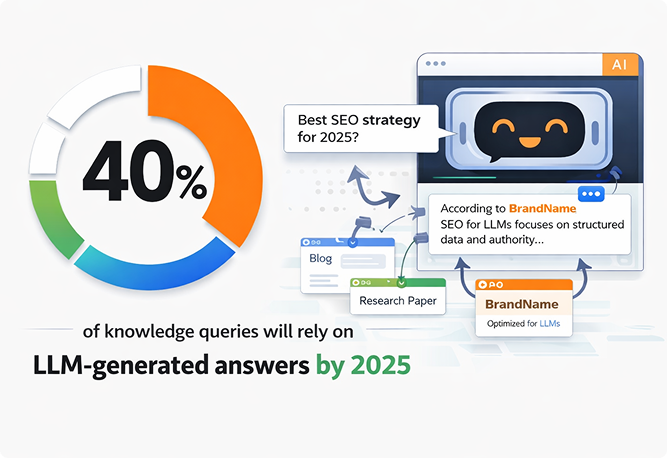

Structure content for easy reference in LLM outputs.

Ensure content is credible and trustworthy

Optimize for topics LLMs prioritize

Make content easily parseable by AI models
1
Evaluate whether existing content aligns with how large language models retrieve and prioritize information. Identify gaps where content is unclear, outdated, or unlikely to be referenced by AI systems.
2
Restructure content to provide clear, direct answers that LLMs can easily extract and summarize. Use logical headings, concise paragraphs, and explicit explanations to improve AI comprehension.
3
Identify semantically rich keywords and topic clusters commonly used in AI-generated responses. Align content with user intent and conversational queries that LLMs prioritize.
4
Track how content appears across AI platforms and discovery tools over time. Continuously refine strategy based on changes in AI behavior, visibility, and performance signals.
Your content appears directly inside AI-generated answers, increasing brand exposure where users now search.
AI surfaces your brand to high-intent users who are actively researching solutions.
Your content stays discoverable as search shifts from traditional engines to LLM-powered experiences.

Ready to scale your agency with GEO SEO, white-label SEO, and white-label link-building services? Explore our pricing and packages to see how we help agencies like yours grow efficiently and profitably.
